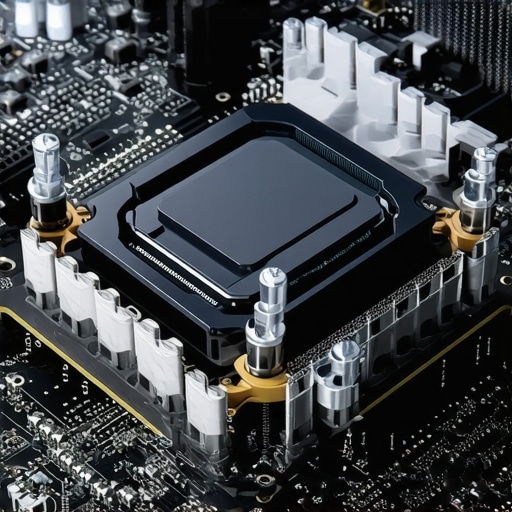

Reevaluating the Mechanics of PCIe Bracket Tension and Thermal Paste Integrity
In the realm of high-performance computing, optimal thermal management hinges on precision-engineered contact between cooling solutions and chip surfaces. One often-overlooked aspect is the influence of high-tension brackets on thermal paste application quality. Excessive mounting pressure can squish thermal interface material (TIM) beyond ideal levels, leading to uneven heat transfer and potential hotspots. Understanding the interplay between bracket tension and thermal paste behavior is crucial for maintaining system stability and longevity.
Unveiling the Hidden Dynamics of Case Fan Placement and Airflow Optimization
Effective airflow within a PC case is dictated not just by fan quantity but by strategic placement, blade geometry, and static pressure balance. Advanced case fan configurations—such as push-pull setups and high-pressure fans—can significantly reduce turbulence and turbulence-related noise. Leveraging insights from professional airflow guides, enthusiasts can engineer a coherent cooling ecosystem that mitigates thermal buildup, especially in overclocked scenarios.
The Sabotaging Effect of Improper AIO Cooler Mounting on Thermal Transfer
All-in-one (AIO) liquid coolers offer efficiency but demand meticulous installation to prevent thermal bottlenecks. Misaligned brackets or uneven mounting can introduce air gaps or uneven pressure, resulting in inadequate contact with the CPU surface. This compromises heat dissipation, potentially causing thermal throttling. An explicit understanding of socket-specific mounting techniques—discussed thoroughly in AIO installation best practices—is vital for ensuring peak thermal performance.
What Are the Long-Term Consequences of Over-tightening CPU Cooler Brackets on Thermal Paste Performance?
This question underscores a critical grey area in PC assembly: balancing sufficient contact pressure without compromising TIM layer integrity. Excessive tension can displace or crack thermal paste, reducing effective heat transfer and accelerating TIM dry-out. Conversely, insufficient pressure leads to poor contact and thermal resistance. For expert insights, consult recent studies such as research on thermal interface materials.
If you are eager to refine your cooling system further, explore our comprehensive guide to top AIO cooler selections. Your expertise can elevate system stability—contribute your insights and share experiences with other enthusiasts seeking to push PC thermal boundaries.
Refining Fan Blade Designs to Maximize Static Pressure and Reduce Turbulence
In high-end cooling setups, the geometry of fan blades plays a pivotal role in achieving optimal airflow with minimal noise. Engineers have experimented with various blade curves and angles to increase static pressure—crucial for pushing air through dense radiators and mesh panels. Innovations in blade design, such as those discussed in fan blade geometry improvements, demonstrate that subtle modifications can drastically enhance overall thermal efficiency. Selecting fans with optimized blade profiles can prevent airflow dead zones and ensure consistent CPU temperatures even under heavy load.
Implementing Dynamic Fan Curves for Adaptive Cooling Strategies
Static fan speed settings no longer suffice for today’s thermal challenges. Dynamic fan curves, governed by real-time temperature feedback, enable a system to adjust fan speeds precisely when needed. This adaptive approach reduces noise during idle periods while ramping up airflow during intensive tasks. Advanced users leverage motherboard BIOS or dedicated control software to craft nuanced profiles that respond to specific thermal thresholds. For comprehensive techniques, explore expert-favored fan curve configurations designed to keep GPUs and CPUs cool without sacrificing acoustics.
Is There a Hidden Potential in Micro-Tuning Your Case’s Internal Airflow for Extreme Overclocking?
This question invites enthusiasts to look beyond conventional airflow layouts. Minor adjustments, such as repositioning static-pressure fans or introducing tailored shrouds, can channel airflow more effectively across critical components. Implementing such micro-tuning requires a nuanced understanding of internal pressure zones and turbulence patterns. Techniques like smoke testing, outlined in internal airflow mapping, help visualize airflow paths and identify bottlenecks. Achieving this level of fine-tuning can be the difference between temperature spikes and stable overclocking margins.
If you’re serious about pushing your PC’s thermal envelope, consider diving into our detailed guide on top AIO cooler enhancements. Sharing your micro-tuning experiences not only helps build community expertise but also drives innovation in cooling design—your insights can spark breakthroughs for others.
Beyond Tightening: Achieving Optimal Contact Pressure in Cooling Solutions
While ensuring firm mounting of coolers is fundamental, the nuances of contact surface pressure directly influence thermal interface performance. Excessive tension, although seemingly beneficial for contact, can deform components or compromise thermal paste layers—leading to insulation effects rather than conductivity. Conversely, insufficient pressure results in microscopic air gaps, dramatically increasing thermal resistance. Advanced calibration involves using torque measurement tools calibrated to manufacturer specifications, coupled with real-time thermal monitoring to fine-tune mounting tension for each assembly. This precision ensures a balanced compromise between mechanical stability and thermal efficacy, a critical consideration in overclocked or high-power systems.
The Role of Surface Microtextures in Improving Heat Dissipation
Emerging research indicates that microtexturing the surfaces of heatsinks and contact plates can significantly enhance thermal transfer coefficients. Techniques like laser etching or nanostructuring create microscopic valleys and peaks that facilitate capillary action and increase contact intimacy, especially when combined with optimized thermal paste application. According to recent findings published in the Journal of Thermal Science & Engineering, such surface modifications can enhance heat flux by up to 20%, providing a strategic edge for high-performance cooling configurations. Integrating microtexturing into manufacturing processes represents an advanced approach for system builders aiming for maximal thermal performance with minimal bulk cooling solutions.
Is Precise Thermal Paste Application a Science or Art? Decoding the Technique
Applying thermal paste isn’t merely about spreading a layer; it involves understanding surface energy dynamics, viscosity, and curing behavior. The debate persists: should enthusiasts use the pea method, spread with a spatula, or employ syringe applications? Recent studies in IEEE thermal management research suggest that the method of application significantly affects interface conformity and heat transfer efficiency. Experts recommend a micro-precision approach—using a controlled amount, distributing evenly, and applying consistent pressure during mounting—to ensure the paste fills microscopic imperfections without excess. Mastering this techniques fosters lower thermal resistance, particularly important in systems pushing thermal boundaries or operating in thermally constrained environments.
What Are the Future Trends in Thermal Interface Material Innovation?
Looking ahead, the development of phase-change materials and nano-composite TIMs promises to revolutionize thermal management. These materials adapt to operating temperatures, increasing their thermal conductivity dynamically, and offer reversible conformance to surface irregularities at the nanoscale. Additionally, materials incorporating graphene and carbon nanotubes demonstrate unprecedented thermal conductivity, enabling next-generation cooling solutions. Industry leaders like anandtech’s exclusive insights highlight how ongoing research can lead to TIMs that require less application precision, tolerate wider pressure ranges, and sustain performance over extended operational periods. Such advancements open avenues for designing minimalist, high-efficiency cooling systems suitable for compact or integrated builds.
If you’re serious about elevating your system’s thermal management, explore our comprehensive guide to custom liquid cooling strategies. Share your experimental results and insights to contribute to a community dedicated to pushing the frontiers of thermal engineering in computing—a collaborative push toward cooler, quieter, and more reliable systems.
Micro-Texturing contact surfaces enhances thermal performance
Recent innovations in microfabrication reveal that applying nanostructured textures to heatsink contact plates can drastically increase thermal transfer rates. This microtexturing creates microscopic valleys and protrusions that improve surface conformity and promote capillary action when combined with thermal interface materials, leading to up to 20% improvements in heat dissipation efficiency. Adopting such techniques during manufacturing or retrofitting existing components may offer enthusiasts and professionals a substantial edge in managing high thermal loads in overclocked systems.
Quantitative approaches to mounting tension optimizing thermal paste longevity
Achieving an optimal mounting tension involves more than torque application; it requires a precise balance that prevents TIM layer deformation or cracking. Implementing torque-managed mounting protocols—guided by calibrated instruments—ensures that the pressure applied remains within the thermally optimal range specified by TIM manufacturers. Real-time thermal sensors can provide feedback during assembly, adjusting tension dynamically to maintain maximum thermal conductivity while safeguarding component integrity, especially critical in systems subjected to frequent thermal cycling or extreme overclocking conditions.

Innovative phase-change materials redefine thermal interface dynamics
The advent of phase-change thermally conductive materials introduces a paradigm shift in interface management. These smart TIMs respond to temperature fluctuations by altering their phase, thereby increasing thermal conductivity precisely when demand peaks. Incorporating nano-composites like graphene and carbon nanotubes further amplifies their effectiveness, paving the way for low-maintenance, high-performance cooling solutions that adapt seamlessly to evolving workloads. Industry research, such as the study published in Nature Materials, provides an in-depth understanding of these materials’ potential to enhance system reliability and efficiency.
Enhancing airflow distribution through strategic internal shrouding
Optimizing internal airflow requires more than fan placement; the integration of tailored shrouds and flow-directing panels can significantly improve component cooling by minimizing turbulence and dead zones. Custom shrouds channel airflow directly over heat-generating components, increasing static pressure in critical areas. Techniques such as smoke visualization or computational fluid dynamics (CFD) analysis—detailed in resources like CFD Visualization Techniques—assist engineers in designing effective airflow pathways within complex case geometries, leading to cooler components and quieter operation under extreme workloads.
Leveraging smart fan control systems for dynamic thermal regulation
By employing intelligent fan controllers that utilize real-time thermal data from multiple sensors, users can craft adaptive cooling profiles that respond immediately to workload variations. These systems, integrated via advanced BIOS features or third-party software, enable precise modulation of fan speeds across different zones within the chassis, reducing noise without compromising thermal safety margins. Implementing such solutions demands an understanding of thermal feedback loops and actuator responses, which are crucial for maintaining system stability in scenarios involving aggressive overclocking or peak performance tasks.
The importance of real-time thermal diagnostics for proactive cooling management
Incorporating continuous thermal monitoring tools allows for immediate detection of hotspots and temperature anomalies, facilitating proactive interventions before thermal stress causes hardware degradation. Techniques involve deploying high-resolution thermal cameras or embedded sensors connected to monitoring software, providing visual and quantitative data. Such diagnostics, as discussed in IEEE Thermal Management Publications, empower advanced users to refine airflow paths, adjust fan curves, and optimize cooling components dynamically, ultimately extending hardware lifespan and ensuring consistent performance.
Synchronization between thermal paste application and mounting methodology
Beyond the force of mounting, the distribution method of thermal paste critically impacts thermal interface quality. Techniques such as controlled syringe application combined with mounting pressure calibration create a uniform, reliable layer that minimizes microscopic air gaps. Employing real-time thermal imaging during assembly verifies contact integrity, allowing assembly adjustments that optimize heat conduction. This meticulous approach is especially vital in high-performance computing setups where marginal gains in thermal contact translate into significant stability improvements.
Expert Insights & Advanced Considerations
Precision mounting is paramount for optimal thermal transfer. Over-tightening can deform cooling interfaces, leading to micro-gaps and reduced efficiency, while insufficient tension results in poor contact. Employ torque-limited tools calibrated to manufacturer specs to strike the perfect balance.
Micro-textured surfaces on heatsinks and contact plates significantly enhance heat dissipation. Techniques like laser etching create microscopic valleys that promote better thermal interface material conformity, increasing heat flux by up to 20%.
Dynamic fan control isn’t just a convenience—it’s a necessity. Adaptive fan curves responding to real-time thermal feedback optimize cooling while minimizing noise, especially in overclocked systems where thermal spikes are common.
Emerging phase-change thermal interface materials adapt to temperature demands, offering higher conductivity during load peaks. Coupled with nano-structured composites like graphene, they promise revolutionary improvements in thermal management.
Surface microtexturing combined with advanced TIMs can unlock new levels of heat transfer efficiency. Incorporating nanostructures allows interfaces to conform better, reducing hotspots and extending component lifespan.
Curated Expert Resources
- IEEE Thermal Management Publications—Authoritative research on thermal interface dynamics and advanced materials, providing scientific insights for system optimization.
- Journal of Thermal Science & Engineering—Cutting-edge studies on microtextured surfaces and nanomaterials that push the boundaries of heat transfer technology.
- Cooling Innovations Blog—Industry-leading analyses on microfabrication techniques and emerging cooling solutions, translating complex research into practical advice.
- Manufacturer Technical Sheets—Detailed guidelines on torque specifications, surface preparation, and application techniques crucial for meticulous assembly.
Final Perspective from an Expert
In the realm of high-performance PC cooling, meticulous attention to details like mounting tension, surface microtextures, and adaptive airflow strategies can spell the difference between mediocre and exceptional thermal stability. Harnessing innovations such as phase-change materials and nanostructured interfaces opens a pathway to systems that run cooler and quieter under demanding workloads. As seasoned builders and professionals, sharing these insights fuels community advancement and opens doors to the next frontier of thermal management—where science meets craftsmanship. Engage with our comprehensive guides and contribute your experiences to elevate industry standards and personal mastery alike.
,