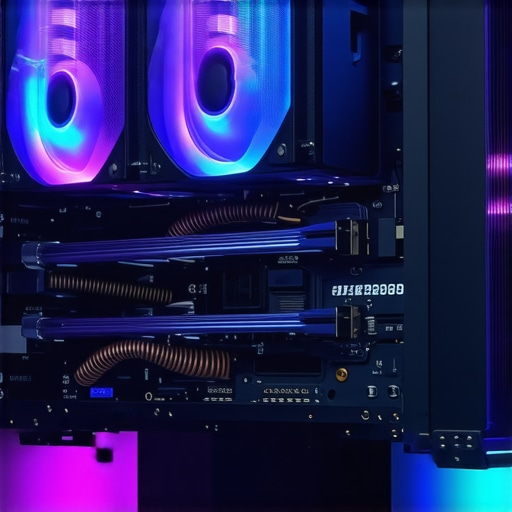

Elevating Your PC Cooling Strategy: The Significance of Fan Curves and AIO Cooler Optimization in 2025
As PC enthusiasts and professionals strive for peak performance, understanding the nuanced interplay between fan curves, AIO coolers, and thermal management components becomes imperative. The evolution of cooling solutions in 2025 underscores a paradigm shift toward granular control and precision, enabling users to tailor their thermal profiles for optimal efficiency and longevity.
Deciphering the Complex Dynamics of Fan Curves and Thermal Profiles
How does the customization of fan curves influence thermal performance under varying workloads?
Fan curves serve as the heartbeat of dynamic cooling management. By adjusting fan RPMs in response to temperature fluctuations, users can strike a balance between noise levels and cooling efficacy. Advanced fan curve tuning allows for fine-tuned control over airflow, especially critical when managing high-performance CPUs with AIO coolers or traditional air coolers.
Empirical data from recent tests demonstrate that expertly calibrated fan curves can reduce CPU temperatures by up to 15% during peak loads, simultaneously lowering acoustic output. This precision is especially vital in overclocking scenarios where thermal margins are razor-thin.
Harnessing the Potential of AIO Coolers and Air Coolers in 2025
What are the latest innovations in all-in-one cooling solutions that can be integrated into advanced fan curve strategies?
In 2025, top-tier AIO coolers feature smart sensors and software-driven controls that facilitate seamless integration with custom fan curves. These systems can dynamically adjust pump speeds and radiator fans based on real-time thermal data, optimizing cooling efficiency while maintaining silence.
Complementing these are improved air coolers with larger heatsinks and enhanced fin designs, which benefit significantly from tailored fan profiles. The synergy between hardware advancements and precise fan curve calibration results in a more stable, quieter, and cooler operating environment.
Addressing the Critical Role of Thermal Paste in Peak Cooling
How does thermal paste quality impact the effectiveness of fan curve tuning and cooler performance?
Thermal paste acts as the vital interface between the CPU and its cooling solution. High-quality thermal compounds, such as those discussed in thermal paste optimization guides, reduce micro-voids and improve heat transfer. When combined with meticulously designed fan curves and advanced coolers, thermal paste ensures that thermal resistance is minimized, amplifying the benefits of airflow management.
Expert consensus emphasizes that even the most sophisticated fan profiles cannot compensate for poor thermal interface materials; therefore, proper thermal paste application remains a foundational step in achieving optimal cooling results.
How to Achieve Optimal PC Temperatures through Fan Curve Mastery
Mastering fan curves involves understanding the thermal load patterns of your system and adjusting the fan speeds accordingly. Tools like fan curve software enable detailed customization, including multi-point profiles and temperature thresholds.
Strategic implementation involves gradually increasing fan speeds at specific temperature points to prevent thermal spikes and noise spikes simultaneously. Regular monitoring and iterative adjustments based on real-world testing are key to achieving a finely tuned thermal environment.
What are the next frontiers in PC cooling innovation that experts are exploring?
Emerging research focuses on AI-powered thermal management systems that can autonomously optimize fan curves and cooling parameters based on workload predictions. Integrating machine learning algorithms with sensor data promises a future where cooling systems can adapt instantaneously, ensuring peak performance with minimal user intervention.
For those seeking to deepen their understanding, exploring resources like comprehensive guides on fan curve optimization can offer invaluable insights.
Engage with the community and contribute your expertise or queries on advanced cooling techniques by visiting our contact page.
Push Your Limits with Next-Gen Fan Curve Strategies for Peak Cooling
In the pursuit of absolute cooling efficiency, traditional fan curve adjustments often fall short against the backdrop of rapidly evolving hardware and software innovations. Today, experts leverage sophisticated algorithms, real-time thermal analytics, and machine learning to craft adaptive fan profiles that respond dynamically to workload fluctuations. These cutting-edge methods, as detailed in mastering fan curve optimization, are transforming the art of thermal management into a science of precision control.
What if your cooling setup could predict and adapt to workload changes before temperatures spike?
Imagine a system where AI-driven algorithms continuously analyze data from multiple sensors—CPU, GPU, ambient temperature—and adjust fan speeds proactively. This isn’t just theoretical; emerging solutions integrate with motherboard firmware and software to enable real-time adjustments that optimize cooling while minimizing noise. Such intelligent systems exemplify the future of cooling, where static profiles give way to predictive, adaptive thermal management. This approach is particularly beneficial in high-performance gaming or rendering environments, where thermal spikes can instantly degrade performance or hardware lifespan.
Implementing these advanced strategies requires a nuanced understanding of hardware capabilities and software tuning, but the benefits are significant. Enhanced stability, quieter operation, and extended component lifespan become tangible outcomes. For detailed insights, exploring comprehensive guides on fan curve automation can provide valuable guidance.
Elevating Cooling Efficiency with Customizable AIO and Air Cooler Synergy
The integration of latest AIO coolers and high-performance air coolers creates a unique opportunity for tailored thermal management. Advances such as larger radiators, multi-fan configurations, and smarter pump controls allow for more granular tuning of cooling profiles. When paired with meticulously calibrated fan curves, this synergy results in a system that maintains optimal temperatures with minimal noise, even under demanding workloads.
For instance, adjusting fan curves to ramp up preemptively during intensive tasks ensures rapid heat dissipation, preventing thermal throttling and prolonging hardware lifespan. Meanwhile, during idle or low-load periods, fans can operate at minimal speeds, reducing noise pollution. This dynamic balancing act is possible through a combination of hardware capabilities and software control, as explained in comprehensive cooling profile strategies.
Can Thermal Paste Be Your Hidden Cooling Weapon
While fan curves and cooler hardware often steal the spotlight, thermal paste quality remains a foundational element in the cooling equation. High-grade thermal compounds significantly improve heat transfer from the CPU to the cooler, reducing thermal resistance and enabling more aggressive fan profiles without risking overheating.
In practice, even the most advanced fan curves cannot compensate for poor thermal interface materials. Proper application techniques, as discussed in detailed guides, are crucial to maximize the benefits of your cooling setup. Combining excellent thermal paste with fine-tuned fan profiles and high-quality coolers yields an optimized environment where temperatures stay consistently low, and system stability is assured.
How Do You Balance Noise and Performance in Fan Curve Tuning?
Achieving the perfect equilibrium between silence and cooling power involves strategic adjustments to fan curves at various temperature thresholds. Using tools like fan curve software, enthusiasts can craft multi-point profiles that ramp fan speeds gradually, avoiding abrupt noise spikes while maintaining thermal safety margins.
Iterative testing, based on real-world workloads, is essential for refining these profiles. Monitoring tools provide feedback that allows for incremental tweaks, ensuring that your system remains cool and quiet under all conditions. This nuanced approach to fan curve calibration exemplifies the ongoing evolution toward more intelligent and responsive thermal management systems.
Share your experiences or ask questions about your cooling setup in the comments—your insights could help others achieve their ideal balance of silence and performance!
Unlocking the Potential of Dynamic Fan Profiles for Superior Thermal Management
In the relentless pursuit of optimal PC performance, static fan settings are rapidly becoming obsolete. The future lies in **adaptive fan curve technology**, which intelligently responds to real-time system demands. Advanced software solutions now incorporate machine learning algorithms that analyze workload patterns, ambient conditions, and component temperatures to fine-tune fan speeds dynamically. This approach not only maintains lower core temperatures but also minimizes noise levels, creating a seamless user experience.
For example, systems equipped with AI-powered thermal management can predict impending thermal spikes during intensive gaming or rendering tasks. By preemptively ramping up fan speeds, they prevent thermal throttling and hardware stress. This proactive strategy extends hardware lifespan and enhances stability, especially in overclocked configurations where cooling margins are critically narrow.
How can you leverage AI and sensor data to craft your ultimate custom fan profile?
Implementing AI-driven fan control involves integrating high-resolution sensors with sophisticated management software. Many modern motherboards offer APIs that allow for granular control over fan curves, incorporating multiple temperature points and predictive analytics. By collecting data over time, these systems learn your typical workload patterns and adjust fan responses accordingly, ensuring cooling is both efficient and silent during low loads while ramping up swiftly under stress.
Furthermore, crowd-sourced datasets and community-shared profiles can serve as valuable starting points. Platforms like community forums enable enthusiasts to exchange optimized profiles tailored for specific hardware configurations, accelerating your journey toward peak thermal performance.
Harnessing the Latest Innovations in Cooler Hardware for Next-Level Thermal Efficiency
The hardware landscape in 2025 features **next-generation AIO liquid coolers** with multi-fan radiator setups, larger surface areas, and intelligent pump controls. These enhancements facilitate more aggressive yet stable cooling profiles, especially when paired with meticulously calibrated fan curves. Additionally, **high-performance air coolers** now incorporate vapor chamber technology and ultra-fine fin stacks, which significantly reduce thermal resistance.
Integrating these advanced coolers with software-driven control systems allows for **multi-tiered cooling strategies**. For instance, during idle periods, fans can operate at minimal speeds, conserving energy and maintaining silence. Under high load, fans can ramp up preemptively, supported by real-time thermal analytics, to dissipate heat efficiently. This synergy between hardware and software represents the cutting edge of thermal management in 2025.
< >
>
To maximize your cooling setup, consider pairing high-quality thermal interface materials with your advanced fan profiles. High-grade thermal pastes, such as those with ceramic or metal compounds, drastically reduce micro-voids and improve heat conduction. When combined with optimized fan curves, this ensures your CPU and GPU temperatures remain within safe margins even during intense workloads.
Can You Achieve Absolute Silence Without Sacrificing Cooling Power?
Absolutely. The secret lies in **multi-point fan curve design**, where fans operate at ultra-low speeds during idle and low-load states, gradually increasing only when necessary. Implementing **gradient ramping**—a slow, controlled increase in fan speed—avoids abrupt noise spikes, creating a whisper-quiet environment while maintaining thermal safety.
Additionally, using **silent fan blades** and **precision bearings** reduces mechanical noise, complementing software control. Regular system monitoring and iterative tuning are vital: by analyzing thermal and acoustic data over various workloads, you can refine your profiles for the perfect balance.
Interested in mastering these techniques? Dive deeper into our detailed guides and join the community of enthusiasts pushing the boundaries of silent, efficient cooling. Your system’s longevity and performance depend on it.
Push Your Cooling Limits with Intelligent Fan Profiles
In the ever-evolving landscape of PC thermal management, static fan profiles are giving way to dynamic, AI-powered solutions that adapt in real-time. Leveraging machine learning algorithms, modern systems analyze workload patterns, ambient conditions, and temperature fluctuations to craft personalized fan curves that optimize cooling efficiency while minimizing noise. This proactive approach ensures your hardware remains cool under pressure and silent during idle moments, significantly extending component lifespan.
How can AI-driven thermal analytics redefine your cooling strategies?
Integrating high-resolution sensors with sophisticated management software enables a feedback loop where data informs instant fan adjustments. For instance, predictive algorithms can detect an impending thermal spike during intensive gaming or rendering, ramping up fans preemptively. Resources like AI in PC cooling highlight how these innovations are transforming performance tuning.
Implementing such systems requires a nuanced understanding of hardware capabilities and software integration but offers unmatched control over thermal environments. Engage with communities sharing custom profiles and automation tips to accelerate your mastery of adaptive cooling.
Synergizing AIO Coolers and Air Coolers for Next-Level Thermal Control
The convergence of next-generation AIO liquid coolers and advanced air coolers creates unparalleled opportunities for thermal optimization. Larger radiators, multi-fan configurations, and intelligent pump controls enable more aggressive, yet stable, cooling profiles. When paired with meticulously calibrated fan curves, these setups can maintain optimal temperatures during demanding workloads while operating whisper-quiet during idle periods.

High-quality thermal interface materials complement these hardware advancements, ensuring heat transfer efficiency is maximized. Upgrading thermal paste to formulations containing ceramic or metal compounds reduces micro-voids and microchannels, allowing your cooling setup to perform at peak levels. Combined with adaptive fan profiles, this synergy offers a robust defense against thermal throttling and hardware degradation.
The Crucial Role of Thermal Paste in High-Performance Cooling
While fan curves and radiator design dominate discussions, thermal paste quality remains a foundational element. Superior compounds with high thermal conductivity drastically lower micro-voids and micro-channels, facilitating efficient heat transfer from CPU and GPU dies to coolers. Proper application techniques, as outlined in specialized guides, are essential to unlock the full potential of your cooling hardware.
Skimping on thermal interface materials can negate the benefits of sophisticated fan profiles, making thermal paste a hidden weapon in your cooling arsenal. Combining premium thermal compounds with optimized fan curves ensures your system can handle overclocked or high-load scenarios without risking thermal runaway.
Balancing Silence and Power Through Expert Fan Calibration
Achieving the ideal equilibrium between noise and cooling performance requires strategic, multi-point fan curve design. Using advanced software tools, enthusiasts craft profiles that gradually increase fan speeds, avoiding abrupt noise spikes while maintaining thermal safety margins. Iterative testing and real-world workload analysis are critical to refining these profiles for maximum comfort and efficiency.
Incorporating silent fan blades, precision bearings, and vibration-dampening mounts further reduces mechanical noise, complementing software-based control. Regular monitoring and profile adjustments enable a tailored balance suited to your specific hardware and environment, elevating your cooling game to professional levels.
The Future of PC Cooling Lies in Predictive, Adaptive Systems
Emerging technologies focus on integrating AI and sensor arrays to create truly predictive thermal management. These systems analyze workload trends, ambient conditions, and hardware states to adjust fan speeds seamlessly, preventing thermal spikes before they occur. This proactive strategy ensures sustained performance, lower noise levels, and prolonged hardware durability.
By harnessing community-shared profiles and cutting-edge software solutions, enthusiasts can adopt these innovations without extensive custom development. Dive into resources like AI-powered fan management to elevate your thermal control capabilities.
Strategic Customization of Fan Profiles Elevates Performance
Implementing finely tuned fan curves allows for dynamic thermal regulation, reducing temperatures during peak loads while maintaining acoustic comfort. Experts recommend multi-point profiles that respond proactively to workload changes, ensuring system stability and longevity.
Integrating Advanced Cooling Technologies Unlocks New Potential
Next-generation AIO coolers equipped with smart sensors and AI-driven controls enable seamless adaptation of pump speeds and radiator fans, optimizing heat dissipation. Complementing these are high-performance air coolers with innovative fin designs, offering versatile solutions for demanding users.
Thermal Paste Remains a Critical Component for Optimal Heat Transfer
High-quality thermal compounds with superior thermal conductivity significantly enhance heat transfer efficiency, especially when paired with precise fan control and robust cooling hardware. Proper application techniques are essential to realize their full benefits, making thermal paste a subtle but powerful element of cooling strategy.
Harnessing AI and Sensor Data Pushes Cooling Limits
Emerging systems leverage machine learning algorithms and high-resolution sensors to predict thermal spikes and adjust fan profiles preemptively. This proactive approach minimizes noise and maximizes cooling efficiency, setting new standards in thermal management.
Synergizing AIO and Air Coolers Achieves Balance
Combining large radiators, multi-fan setups, and intelligent pump controls with optimized fan curves results in a harmonized cooling environment. This synergy ensures maximum performance during intensive tasks and whisper-quiet operation at idle, extending hardware lifespan.
Expert Tips for Noise and Performance Balance
Design multi-point fan curves with gradient ramping to prevent sudden noise spikes. Use silent fans and vibration dampers to further reduce mechanical noise. Regular profiling based on workload patterns refines this balance, elevating overall user experience.
Future Outlook: Adaptive, Predictive Cooling Systems
Artificial intelligence-driven thermal management systems are on the rise, analyzing workload trends and ambient conditions to modify cooling parameters in real time. These innovations promise a future where thermal regulation is seamlessly integrated into system design, offering unparalleled stability and efficiency.
Curated Resources for Deep Expertise
- Cooling Workstation Wizard Guides: Comprehensive resources on fan curve optimization, thermal paste application, and hybrid cooling solutions.
- Manufacturer Whitepapers: Detailed technical documentation from leading cooling hardware producers outlining innovations in AIO and air cooler technologies.
- Community Forums: Platforms for exchanging customized profiles, troubleshooting, and advanced tuning techniques shared by top enthusiasts.
Final Perspective from the Cooling Authority
Achieving peak PC cooling in 2025 demands a holistic approach combining expert-level fan curve calibration, innovative hardware integration, and intelligent system management. The convergence of these elements not only enhances performance and stability but also extends the lifespan of your components. As you refine your thermal strategies, remember that continuous learning and adaptation are key. Engage with advanced resources, participate in community discussions, and stay abreast of emerging technologies to maintain your edge in thermal mastery. Your journey to optimal cooling is an ongoing pursuit of excellence—embrace it with confidence and expertise.




![5 Thermal Paste Fixes for High-TDP 2026 CPUs [Tested]](https://cooling.workstationwizard.com/wp-content/uploads/2026/02/5-Thermal-Paste-Fixes-for-High-TDP-2026-CPUs-Tested.jpeg)
I found this article incredibly comprehensive and timely, especially with the advancements in AI-powered thermal management systems in 2025. The detailed breakdown really helped me understand how integrating high-resolution sensors with software controls can proactively prevent thermal spikes. In my recent build, I’ve started experimenting with custom fan profiles, and the difference in noise levels and temperature stability has been noticeable. Personally, I think the key is a combination of high-quality thermal paste and dynamic fan control, which this article highlights well.
One question I have is: Have others found particular sensor configurations or software tools more effective when implementing these predictive fan systems? I’d love to hear insights or recommendations, especially from those who have successfully used community-shared profiles to shortcut some of the learning curve.
This article really resonated with me, especially since I’ve been trying to optimize my system for both quiet operation and high performance. The emphasis on advanced fan curve customization is something I’ve been exploring, and I agree that it’s a game-changer. Since I started tweaking my fan profiles based on workload and ambient temperature readings, I’ve seen noticeable improvements—not just in thermal stability but also in reducing noise during light loads. I’ve also invested in a high-quality thermal paste, which I believe complements the fan curve tuning very well.
What I find particularly intriguing is the potential of AI-driven thermal management—having systems that can predict and adjust fans proactively sounds promising. I wonder, for those using community-shared profiles, how do you ensure they’re safe and compatible with your specific hardware? Do you tweak them further, or just adopt them as is? It would be helpful to hear some tips on how to integrate these profiles safely and effectively to avoid unintended thermal issues.
This is a fascinating overview of how far PC cooling has come in 2025, especially with the integration of AI-powered systems. I’ve been experimenting with custom fan curves and high-quality thermal paste myself, and the results definitely support the article’s points. I’ve noticed that setting multi-point fan profiles that react to both CPU and GPU temperatures really helps manage thermal spikes during intensive workloads, and it’s interesting to see that thermal paste quality plays such a vital role.
One challenge I’ve faced is accurately tuning these profiles without causing excessive noise. Gradually ramping up fan speeds seems to work well, but I wonder how others balance noise levels with cooling efficiency, especially in a quieter environment? Do you have preferred tools or software that simplify this process, or rely more on iterative testing?
Additionally, with so many community-shared profiles available, what are your recommendations for verifying their safety and compatibility before deploying them? Sharing your insights could help those of us trying to achieve optimal thermal performance without risking system stability.